
Can fragrances really change your mood? Inside the new neuroscience of scent

Fragrance has always traded in emotion. But perfume houses are now making a more ambitious bet: that the right combination of scent molecules might not simply make you smell good, but make you feel good, too.
And they’re increasingly turning to neuroscience to prove it.
Which is how I find myself at The Singapore EDITION’s Punch Room, having my brainwaves measured at a perfume launch.
At the unveiling of the latest fragrance from INITIO Parfums Privés, the French niche fragrance house, an EEG headband is fastened around my forehead before I’m presented with a series of scents to smell. As someone who can spend an unreasonable amount of time deciding whether I actually like a perfume, the prospect of having my brain weigh in feels strangely useful.

The experience uses Feel’Tech, a technology developed by digital consultancy Micropole in collaboration with BrainCo, the US neurotechnology company incubated at the Harvard Innovation Lab.
As I sniff the blotters, the EEG headband records the electrical activity generated by my brain, tracking five frequency bands — delta, theta, alpha, beta and gamma — whose patterns are associated with different states of arousal, attention and relaxation.
Rather than asking me to rate how a perfume makes me feel, the system is designed to pick up changes happening beneath that conscious appraisal.
From this, the device generates what it calls a Focus Calm Score, which is used to identify the fragrance profiles that appear to resonate most strongly with me.
It’s a lot of tech for what ordinarily involves a spritz on the wrist and a few hours of indecision. But it reflects a much bigger shift in perfumery.
Brands are increasingly looking beyond whether a fragrance is sexy, sophisticated or smells vaguely like a Mediterranean holiday, towards a more tantalising proposition: could scent actually make us calmer, happier, more focused — or simply feel a little better?

The mood–scent connection
For INITIO, the idea that fragrance can influence how we feel isn’t entirely new.
Since its founding in 2015, the house has explored the relationship between scent and emotion, creating fragrances around more instinctive states such as attraction, confidence and seduction.
“With this new collection, we are exploring a new territory. It’s an emotion we all strive for, these days more than ever: joy,” says Sara Toselli, Regional Marketing Manager APAC at INITIO Parfums Privés.
Rather than treating joy as a single sensation, INITIO has interpreted it in different ways through scent. Wild Rush, built around bergamot and lavender, is intended to evoke the more energising side of happiness. Sugar Blast, meanwhile, takes the pleasure route, with a gourmand blend of vanilla, praline, coconut, rum, cashmeran, ambroxan and lavender.

Somewhat surprisingly, the EEG device gets it right: my brain apparently perks up for Sugar Blast, the sweet scent I’d already picked as my favourite.
“Sugar Blast is joy through pleasure and dopamine,” Toselli explains. “If you close your eyes, it’s the feeling you have when you eat your favourite candy.”
A few weeks later, at another fragrance launch, there isn’t an EEG headset in sight.
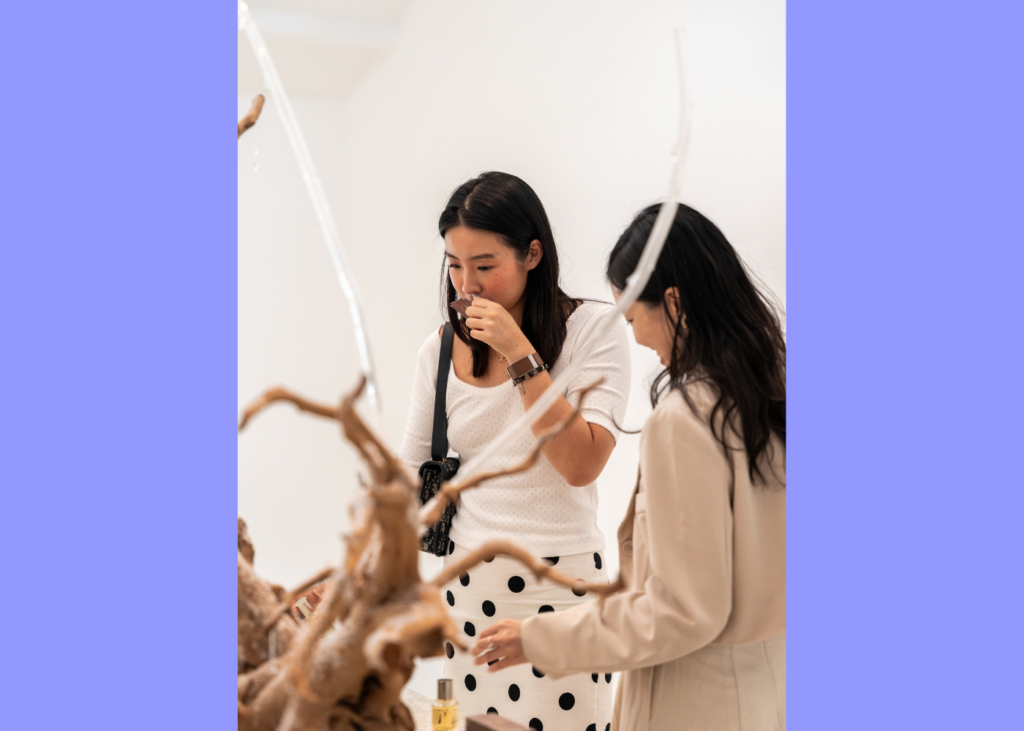
Instead, at the unveiling of Thai wellness brand PAÑPURI’s new Care Eau de Parfum collection, we’re taken through a decidedly more analogue olfactory journey. Fragrance is spritzed onto pieces of cloth hanging from the ceiling of an art gallery, with the simple instruction to inhale and notice how each one makes us feel.
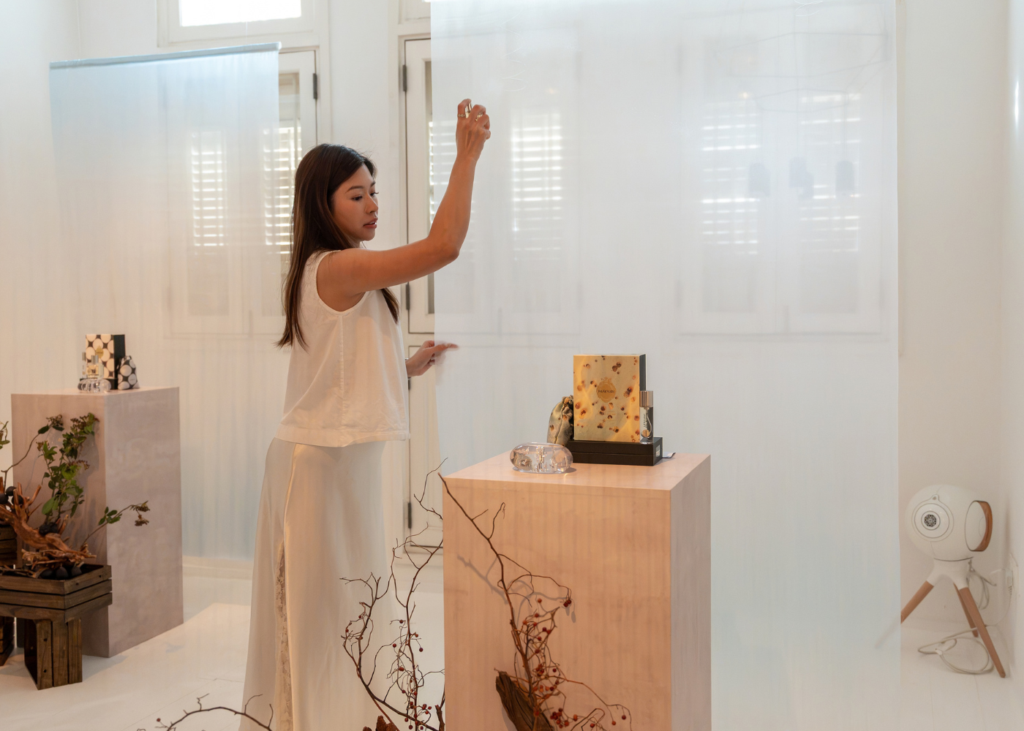
If any brand understands the power of scent to set a mood, PAÑPURI has had plenty of practice.
Walk into one of its spas in Bangkok and the effect is almost immediate: before the massage has begun or anyone has told you to relax, the fragrance filling the space has already done some of the work.
For founder and CEO Vorravit Siripark, this relationship between fragrance and wellbeing predates the brand itself. Growing up in Thailand, he remembers watching his grandmother infuse jasmine into jars of cool rainwater, which the family would drink, serve to guests and use to cool themselves on hot afternoons.
When he founded PAÑPURI in 2003, that philosophy eventually found expression in its first fragrance, Siamese Water.
“I was trying to give shape to something I’d always known — that fragrance can do more than smell beautiful, he says.
Consumers, he believes, are now thinking about fragrance in much the same way.
“A decade ago, it was, ‘What does this smell like?’ Increasingly, it’s, ‘How does this make me feel?’” he says.
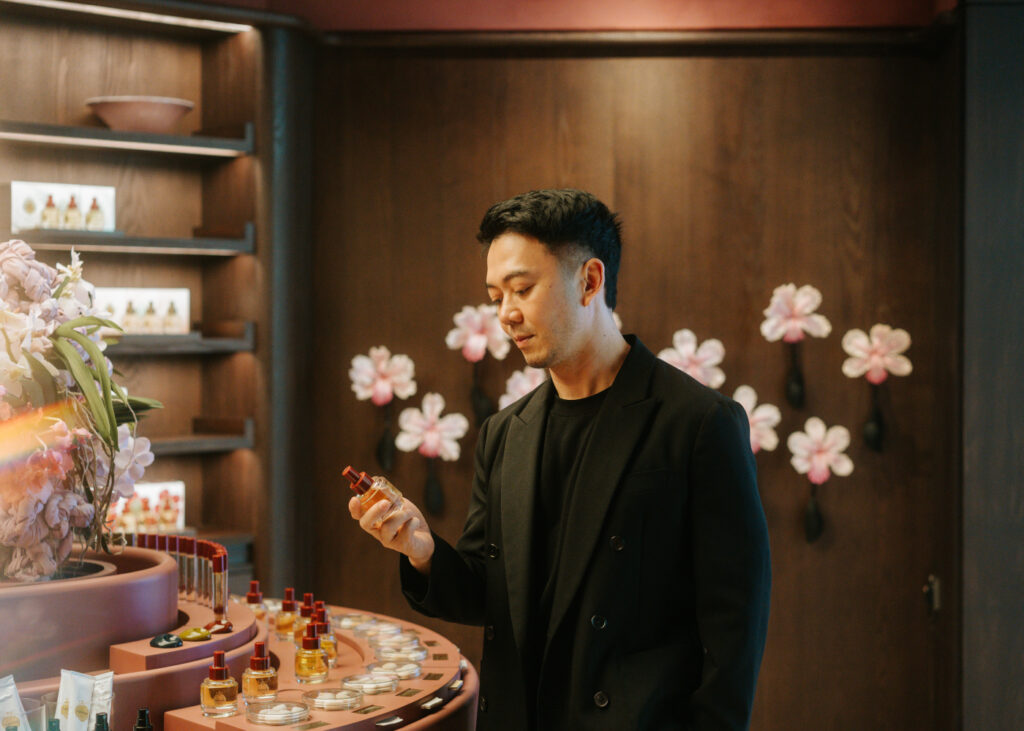
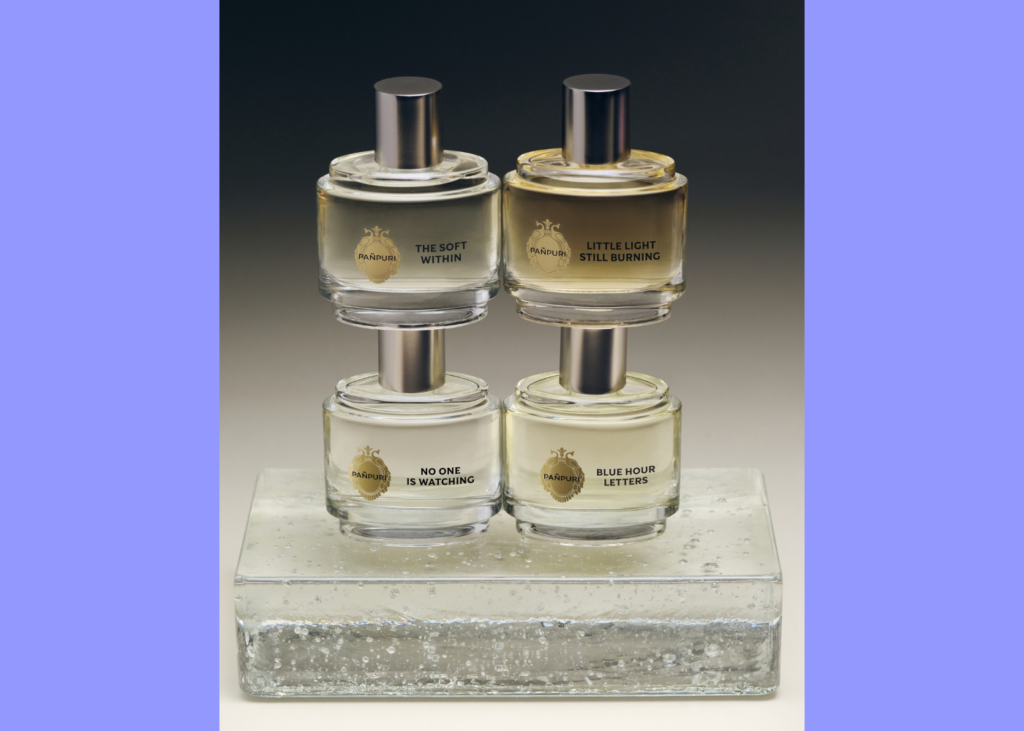
PAÑPURI’s new alcohol-free Care Eau de Parfum collection is built around precisely that question. The brand stops short of promising to change your mood; the idea for its ten fragrances is subtler — to choose a scent according to what you might need or want to feel at a particular moment.
Even the names read more like fragments from a diary than conventional perfumes.
There’s The Quiet Between, a green blend of tomato leaf and galbanum conceived around clarity and grounded calm, while I’ll Stay Until You Sleep, perhaps the most evocatively named of the lot, pairs tuberose and vanilla with ideas of comfort, safety and deep relaxation.
Can you bottle a better mood?
There is a reason scent can feel unusually powerful.
According to Dr Andrei Dragomir, a Senior Research Fellow at the N.1 Institute for Health at the National University of Singapore, unlike our other major senses, olfactory signals take a distinctive route through the brain.
Smell information travels from receptors in the nose to the olfactory bulb and onward to olfactory cortical regions, with close connections to areas involved in emotion, memory and higher-order processing, including the amygdala, hippocampus and orbitofrontal cortex.
It helps explain why a smell can suddenly transport you to your grandmother’s kitchen, an old boyfriend’s T-shirt or a holiday you haven’t thought about in years. Our experience of scent is deeply entangled with memory, emotion and what our brains have previously learnt that particular smell means.
And there is growing evidence that smell can produce measurable effects beyond simply stirring up memories.
Dragomir points to research showing that exposure to certain odours can affect sleep quality and sleep architecture, as well as alleviate stress under particular conditions.

His own research group at NUS has investigated the effects of odours on drivers’ alertness and found that certain smells could temporarily — but significantly — improve performance on specific driving tasks.
Working with fragrances developed by Procter & Gamble’s Singapore Innovation Center, the researchers tested two formulations: an alerting citrus-and-mint scent containing citral and menthol, and a relaxing lavender-based scent containing linalool and linalyl acetate.
Participants themselves perceived the fragrances as alerting and relaxing respectively.
But Dragomir also urges caution.
While he says there is “substantial scientific evidence” that the effects of odour exposure can be real and statistically significant, that doesn’t mean one perfume will reliably produce the same response in everyone.
The effects can be “highly individualised”, depending on the smell itself, personal preferences, how it is delivered and even the context in which we encounter it.
In other words, lavender doesn’t necessarily come with a universal calm button, nor does citrus guarantee an instant shot of energy.
“I would say that marketing starts where such overarching claims of one-fits-all solutions are being made,” Dragomir says.
What your nose knows
The connection between smell and the brain becomes even more intriguing as we get older.
Our sense of smell naturally tends to deteriorate with age. But an unusually poor or rapidly declining ability to smell is also increasingly being studied as a potential early warning sign of neurodegenerative diseases, including Alzheimer’s and Parkinson’s — sometimes before more obvious cognitive symptoms emerge.
A 2022 University of Chicago Medicine study followed 515 older adults and found that those whose sense of smell declined rapidly were more likely to subsequently show poorer cognition, a greater risk of dementia and changes in brain regions associated with smell and memory.
Another research from the US National Institute on Aging has found a similar relationship. In one study, older adults who were better at identifying smells tended to experience slower cognitive decline and less loss of brain volume over time, particularly in areas involved in memory and thinking.
Smell can deteriorate for all sorts of reasons, from ageing and viral infections to problems in the nose itself. Nor have scientists established that improving your sense of smell will prevent dementia.
But it has raised a fascinating possibility: if losing olfactory function can accompany changes in the brain, could deliberately exercising our sense of smell be good for it?
Enter olfactory training, or smell training. Some researchers are studying whether repeated exposure to odours, known as olfactory training, could have effects on certain cognitive abilities and age-related cognitive decline.
It typically involves deliberately smelling a selection of distinct odours every day, paying attention to each one and repeating the exercise over weeks or months.
The technique is already used clinically to help some people with impaired smell, including those who lost or distorted their sense of smell following viral infections such as Covid-19. But researchers have also begun asking a more ambitious question: might repeatedly exercising the olfactory system have benefits beyond smell itself?
There have been some intriguing results.
In a 2025 randomised trial called Mind Your Nose involving 53 older adults with subjective cognitive decline, participants spent 20 days practising memory tasks using odours. They improved on the smell-memory task they had practised, and researchers also found some evidence that those gains transferred to an untrained visual-memory task.
However, experts say smell training shouldn’t be thought of as a way to prevent or treat dementia. What it does offer is another tantalising clue to just how intimately our noses and brains are connected.
A little experiment in joy
After all this talk of brainwaves, emotional responses and olfactory training, I decide to conduct a considerably less rigorous experiment of my own.
I’ve been spritzing myself liberally with Sugar Blast to see whether it might spark a little joy in the people around me.
Over dinner, I ask a friend what she thinks of the fragrance I’m wearing. She looks momentarily confused.
“I don’t smell anything.”
Mission failed.
My second subject is more encouraging. When I ask her how my fragrance makes her feel, her eyes light up.
“Great! Is that why I feel chattier than usual around you today?”
Success — sort of.
Two friends and one bottle of perfume are hardly a clinical trial. And, as Dragomir points out, our responses to scent are deeply individual, shaped by everything from personal preference to memory and context.
Still, perhaps that’s part of fragrance’s enduring appeal. Whether or not we can engineer happiness into a bottle, a scent can make us pause, remember, perk up — or, apparently, talk a little more over dinner.
And some days, that may be joy enough.
Frequently Asked Questions
Why does smell affect our emotions faster than sight or sound?
Unlike vision, hearing, or touch – which pass through the brain's sensory relay center (the thalamus) first – the olfactory nerve goes directly into the limbic system. Specifically, it connects to the amygdala (the brain's emotional processing hub) and the hippocampus (responsible for autobiographical memory). This direct path triggers emotional and physiological responses almost instantaneously.
What is "aromachology" vs "neuroperfumery"?
Aromachology is the scientific study of the relationship between scents and human psychological states or behaviours, like how a lemon scent can temporarily boost alertness.
Neuroperfumery (aka functional fragrance) is a modern approach in fine fragrance that designs perfumes around specific neuro-active ingredients (like natural terpenes) explicitly tested to influence the nervous system, lower cortisol, or trigger relaxation.
What is the "Proust Effect"?
A phenomenon where a single whiff of a familiar scent triggers a sudden, vivid and deeply emotional memory from years prior. Because olfactory information is stored alongside emotional context in the hippocampus, scent-triggered memories tend to be more emotionally intense than visual or auditory memories.
Can everyone react differently to the same scent?
Yes. While certain botanical compounds (like lavender's linalool) have universal physiological effects, personal associations play a massive role. If a person has a bad childhood memory associated with pine, a pine fragrance will trigger stress rather than a relaxing "forest bath" effect.